The Shift Towards Off-Site Structural Fabrication
High-rise construction in dense urban zones requires rapid structural assembly without compromising on dimensional tolerance and load-bearing performance. Precast concrete technology has transitioned from basic boundary elements to sophisticated multi-storey structural shear walls, hollowcore slabs, and architectural facade panels.
Laboratory-Grade Quality and Curing
By curing concrete panels and structural members under rigorous laboratory-controlled factory environments, contractors achieve remarkable compressive strengths exceeding 70 MPa. Thermal curing cycles and automated batch plants eliminate the moisture variations and hydration defects frequently encountered in on-site casting.
Integration with 5D BIM and Modular Transport
At MF Builders, our structural engineers integrate 3D BIM coordination directly with precasting yards. Every connection plate, rebar splice sleeve, and utility penetration is modeled with sub-millimeter precision before fabrication begins.
Modular precision engineering is no longer an alternative—it is the prerequisite for scaling commercial developments in rapidly densifying metropolitan corridors.
Logistical Sequencing and Crane Allocation
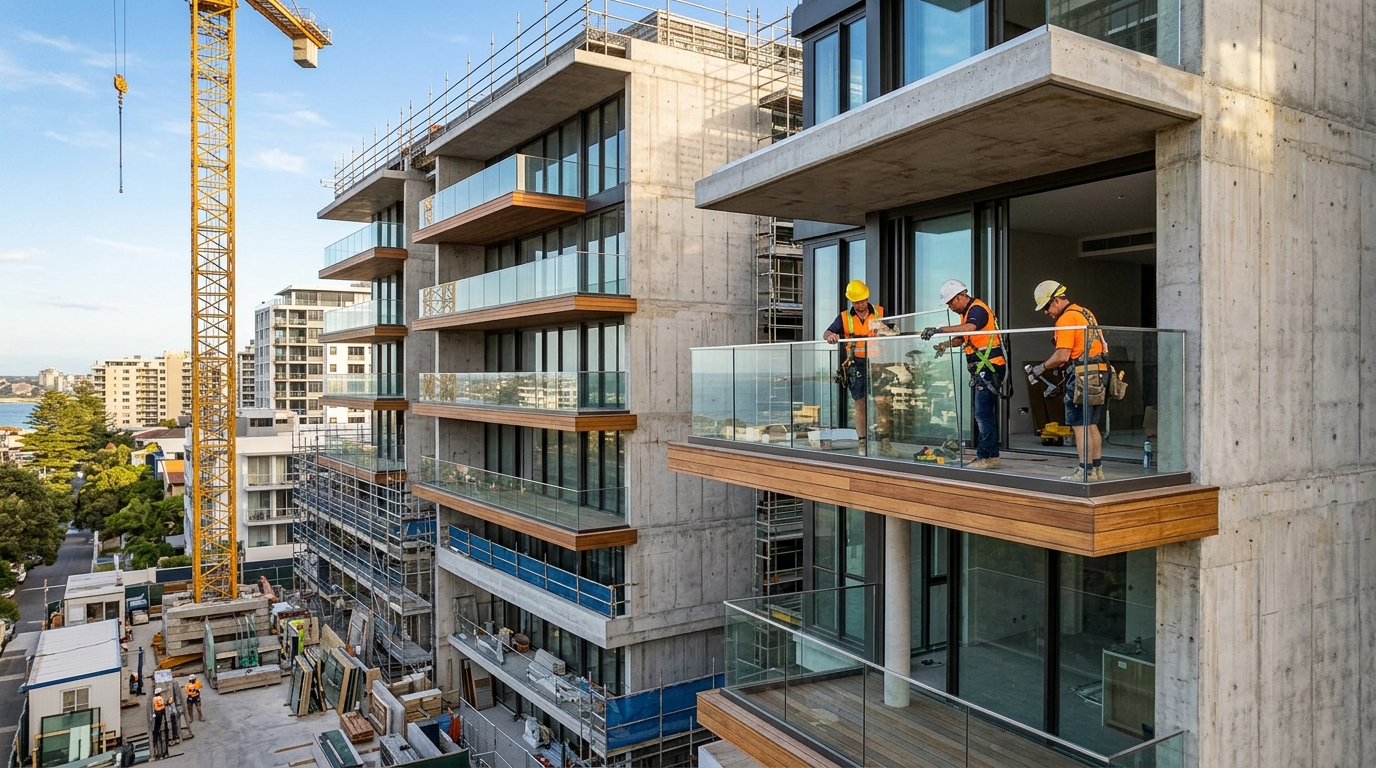
Just-in-time delivery strategies ensure that heavy transport flatbeds pull directly within the radius of high-capacity tower cranes. Panels transition directly from haulers into structural anchors, reducing on-site storage footprints to zero and compressing erection schedules by up to 40%.
Future Horizons: Carbon-Cured Precast Elements
As green building mandates accelerate, incorporating CO2 mineralisation into the curing chambers permanently sequesters embodied carbon while increasing early tensile strengths. This represents the next frontier of sustainable structural engineering.